Patrick Haley

Designing a Custom Home on a Tight Budget

Custom homes allow buyers to completely personalize their future homes, with every detail being handpicked. But how do you achieve the unrivaled experience of a custom home without a lavish budget?

A home is usually the most significant purchase an American can make. Still, many of us are building on a budget. The overall cost of designing and building a custom home can vary dramatically. Design choices will have you either saving or splurging.

G.J. Gardner Homes’ customization capabilities offer home buyers the unique opportunity to not just make sure the home reflects their preferences but the price tag does as well. Our clients are empowered to design according to their budget through our wide range of custom fixtures, plans, and details.

What is the cost of building a custom home?

One of the significant benefits of custom home builds is total flexibility, which extends to everything from colorways to costs. The final figure will drastically vary regarding the average cost of building a custom home. A standard 1,200-square-foot home can cost anywhere from $140,000 to $700,000, with Forbes’ most recent home building study claiming an average of $300,000.

This final cost depends on many factors, like labor and land, but when it comes to materials and design features, it’s up to you to name your price through your choices. We have another blog post discussing custom home pricing in more detail, which may help.

The cost of a custom home is an excellent investment you can make in your living arrangements by perfectly personalizing the space to your lifestyle. With a custom home design, you avoid excess costs in the future by starting out with the ideal floor plan, size, and style for your taste. G.J. Gardner Homes offer the ease of fixed prices that are decided by your customization choices before we even break land.

The process of designing a custom home

With decades of building experience, G.J. Gardner Homes has developed a unique approach to custom builds. When working with your local G.J. team, you are supported by unparalleled home building and design expertise, as well as our masterfully crafted home plans. Homes are universal, so G.J. Gardner Homes don’t seek to reinvent the wheel through our processes and make our clients carry the costs. Instead, we draw on our famed frameworks and patterns and adapt them to match your brief.

For new home builders, you can decide how custom you want your home to be. You’re free to choose from G.J. Gardner Homes’ existing home plans, make changes and tweaks to the original design, or go straight to the drawing board and start anew. When making edits to an existing house plan, you avoid overspending on consultation fees for draftspeople, building designers, and potentially architects.

By building custom with G.J., you can still design a home that’s individualized and in line with your preferences without overspending on the architects’ and designers’ fully bespoke home costs. Our custom home design process wants to make your money work harder and lets you invest in features that will make a real difference to your family rather than fees.

How to design a custom home on a budget

So, if you’re designing on a tight budget, here are a few of our custom home-building mistakes to avoid to keep you under budget.

1. Strategically Splurge

Home designs shouldn’t be a matter of all or nothing. In fact, strategic splurging is the best way to get the most out of your money long term. This involves spending big on specific areas to make the most difference in your daily life. Ultimately, skimping on the most crucial home elements will have you paying even more, to replace damages or wear and tear. Where to spend more will depend on your lifestyle, from the kitchen floor to the bathroom fixtures. In turn, elements of your home that are likely to receive less use daily are the best places to save.

2. Home Plan: Stories, Shape, and Size

Size and shape are some of the most deciding factors regarding home budgets. Of course, bigger homes over multiple stories demand more materials to complete and more specialist constructors. These requirements naturally end up costing more.

Tight budgets don’t demand tiny homes but require effective use of space. Building a home that matches your lifestyle without excess spaces that’ll go unused can be a great design choice for those on small budgets. G.J. Gardner Homes’ small home plans prove that square footage doesn’t decide how spacious your home feels.

Regarding stories, keeping your home on one level is often more affordable than extending it to a second. Even if the house ends up being the duplicate square footage, building a home that’s one story tends to be kinder on tight budgets. A single-story home is simpler to build and requires less expertise to build the structure.

3. Materials

One of the most effective areas to save when designing a custom home on a tight budget is the materials you use. G.J. Gardner Homes offer our clients plenty of choices regarding the materials for your home, working with a diverse range of suppliers.

Some of the best materials for custom homes on a budget include:

  • Concrete sheets
  • Reclaimed wood
  • Metals
  • Stone veneer
  • Bamboo

Our G.J. Gardner Homes designers can work with you and your budget to find the perfect solution for your home so you can stay within budget.

4. Location and Land

The cost of living differs from coastline to coastline, so the location will majorly contribute to the final price of your custom home. Not only will certain cities demand higher spending than others, but where you choose to build in that city will also affect the labor costs. Finding a block with easy access for building can majorly impact the prices as well.

Although this is a step in the initial planning stages, where and what type of land you choose to build on significantly impacts the final costs. Considering the impact location and land choice can have let you allocate more to the design features and avoids excess spending on making an unfit plot work.

The process of a knockdown rebuild: Build a custom home in your beloved neighborhood

Due to the current circumstances of the housing market, buying a new home usually comes at the cost of relocating to a new community. For many of us, where we live has decided our routines, local haunts, and lifestyle, and it can be a challenge to say goodbye to these major tenets of our lives. However, with a knockdown rebuild, you still get to reap the luxuries that come with a new build without restarting in a new area.

Knockdown rebuilds, or teardown rebuilds, involve the demolition of a home to rebuild a new one. The process keeps your existing slate of land but designs and builds an updated house from scratch. This journey lets you create a home designed for you and your lifestyle. It’s the ideal situation: all the excitement and benefits of buying a new home without the inconvenience and costs of selling and moving.

If you’ve outgrown your current home and need an upgrade, a knock rebuild might be the perfect solution. With G.J. Gardner Homes’ custom homes, we can design a new home that’s been personalized to suit your existing land but still meets your needs. Discover the process for a knockdown rebuild today.

Where to start with a knockdown rebuild

Before kicking off your knockdown rebuild project, there’s some initial research and reflection that needs to be done to ensure this is a viable option for you and your family. While you may have no issue knocking down your current home, local zoning laws and regulations may limit or prohibit the demolition of homes in certain areas. This could be due to heritage protection or land issues which make this process unavailable to you. You should start by researching your local municipal and state laws.

Moreover, building a custom home is an investment of your finances, time, and energy, so it’s essential to ensure this land and current location are suitable. We recommend land and soil testing and risk assessment to guarantee your current home area is the prime spot for you to begin this new home journey.

The process of a knockdown rebuild

Designing a knockdown rebuild home involves several steps to ensure the new home meets your needs and desires. Here are the four main steps involved in designing a knockdown rebuild home:

Determine Your Needs and Wants: The first step in designing your knockdown rebuild home is determining your needs and wants. Consider the house size, the number of bedrooms and bathrooms, the layout of living areas, and any special features you want to include. You should look to the future and consider what your preferences will be in the decades to come as well. With G.J. Gardner Homes, we want our homes to adapt and grow as you do so they can stay high-performing long-term.

Start Designing: Once you have a clear understanding of your needs and wants, our G.J. Gardner Homes design team can help you begin planning your dream home. Through decades of design expertise and knowledge of local regulations and building codes, our G.J. Gardner Homes team works alongside you to turn your dream home into a reality. This includes creating floorplans and elevations and deciding on your home’s style.

standard plan

Choose Your Materials and Finishes: After the initial design, you can choose your materials and finish adding your touch to this home. This includes selecting materials for the flooring, walls, roofing, and other structural elements, as well as finishes for fixtures such as cabinets, countertops, and appliances.

Start Demolition and Construction: Before your new home begins, demolitionists must deconstruct the existing home and clear the land. This process tends to be brief and only takes a couple of weeks. Once the knockdown is complete, the rebuild can finally begin.

Once construction is finished, you can return to your beloved block and experience your brand-new home for the first time.

House is demolished

What is the difference between a knockdown rebuild and a house and land package?

A knockdown rebuild home is more straightforward than it may seem. With other home purchases, you’ll dedicate most of your time at the start of the journey to scoping and purchasing a plot of land or house. Instead, with a knockdown rebuild, that time goes to tearing down and clearing your existing home. Once started, the demolition of a home tends to be a quick process and doesn’t rely so much on factors outside your control as land or house purchases do.

Get in touch

If a knockdown rebuild sounds like the perfect solution for you and your family, contact your local G.J. Gardner Homes office today to start the journey. With decades of home-building experience and offices across the country, we’re well-versed in dealing with the unique circumstances of different locations and custom buildings. Contact our friendly team today to learn more.

How to get a home home loan

Home buying is one of life’s most celebrated and sought-after milestones. 85% of Americans say home buying is a top priority. From l planning to the contract exchange, buying a home should be an exciting and rewarding experience. Read ahead to learn how to get a home loan.

Initial planning

Before getting in touch with your bank, you should do some initial planning to begin scoping what home you’re looking for and what’s realistic. By considering your financial circumstances, your location, and your lifestyle, you can streamline your home-buying journey and narrow down your goals.

These first steps involve looking at your finances, goals, and the broader market to set feasible expectations. This is your fieldwork. Research what’s on the market and the available bank lenders, finalize your non-negotiables in a property or a location and estimate your mortgage-to-downpayment ratio. By laying the groundwork, you get yourself in the best position to begin engaging banks for pre-approval and working through the market.

What is the pre-approval process for a mortgage?

While you can still shop for homes on the market without it, a pre-approval gives you a clear understanding of your budget and lets you gauge what properties are within reach. Pre-approval is the first step in the mortgage process, where a bank reviews your financial situation. From your savings, employment, and assets to any existing debts and economic history, your bank evaluates whether you’re a reliable borrower.

Given the competitiveness of today’s housing marketing, pre-approval is highly recommended so you can act fast. With pre-approval, you’re given a precise estimate of your borrowing power so you can confidently make offers.

How to get pre-approved for a home loan?

Pre-approval depends on your bank’s criteria, but as an applicant, you can boost your reputation as a prospective borrower. When reviewing your application, your bank must review your finances and decide if you’re a low-risk borrower.

To boost your borrowing power during pre-approval, it’s essential you can show a responsible financial history. Before applying, check in on your financial situation and ensure it communicates to your bank that you’re a safe candidate to lend to. Some main factors to consider include the following:

  • Income
  • Funds and savings
  • Existing debts
  • Employment history
  • Living expenses and existing assets

Home Shopping

Shopping is the most exciting part of this journey for most home buyers. With G.J. Gardner Homes, you can explore a wide range of homes nationwide and experience our superior home designs. At your local office, we can take you through the unique customization process so you can begin employing your design eye and creating your dream home. Learn more about our home designs today.

Mortgage Application: what is the mortgage loan process?

Once you’ve found your home and your offer gets accepted, it’s time to begin your mortgage application. Pre-approval will put you in a better position for this process. However, your bank can still reject your mortgage application even if you have received pre-approval.

The mortgage application process will need you to submit your personal and financial documentation, which includes the following:

  • W-2s (for the last 2 years)
  • Recent pay stubs
  • Complete bank statements for all financial accounts
  • Signed personal and business tax returns
  • A copy of the signed Purchase and Sales Agreement

So, what is the bank looking for when they review this information? Your lender is trying to gain an accurate snapshot of your financial health and ensure you are a responsible and safe borrower. This will be reflected in consistent income, responsible spending habits, and savings. Once lenders have considered these factors, they can determine whether you’re a good investment for their bank and approve or deny your application.

Where does your credit score come in?

Credit scores are influential in mortgage applications as they rate your ability to borrow funds in the past or your: creditworthiness. It’s a calculated representation of your lending capacity and is one of the most influential factors in mortgage applications that can decide everything from loan approval to loan terms.

The higher your credit score, the better your creditworthiness is and the better your chances are at attaining a mortgage loan. A low credit score, under 600, indicates a less reliable borrower.

This number is a form of risk assessment for bank lenders and determines the type of loan you can receive. Applicants with high credit scores are likely approved for lower down payments and interest rates, whereas applicants with low credit scores will probably have to adhere to stricter terms. This could include a much higher downpayment and interest rate so the bank can cover itself in case of repayment issues.

As credit scores ultimately decide loan terms and approval, the home-buying journey starts much earlier than most think. Your mortgage process depends on your financial behavior over the years, and it’s important to work to attain a good credit score in the years leading up to home buying.

How long does the mortgage process take?

On average, the mortgage process in America will take 30 to 45 days. However, the length of time depends on several different factors. These include the bank, the application type, the accuracy of your application, the underwriting process, and the property itself. Complications in the loan process can double the timeline on average to 60 to 90 days.

Underwriting: what is the mortgage underwriting process?

While reviewing your mortgage application, the bank will complete underwriting. This process reviews your financial situation and is a significant mortgage stage component. An underwriter will assess your creditworthiness by reviewing all relevant information and documents you supplied in your application. The outcome of this process will determine whether the loan is approved or denied.

It’s called underwriting because, at one point in history, bankers would write their names under the risk information to approve the loan.

How long is the underwriting process for a mortgage?

The underwriting process represents one stage in the mortgage approval process carried out by lenders. It usually takes around a week to complete on its own, but it will vary from bank to bank. While this is the main stage of mortgage approval, admin and loan terms are also involved, which make up the rest of the waiting time.

What is the process of paying off a mortgage?

The average mortgage pay-off period is 30 years and involves continual monthly repayments. Your monthly repayment will involve the monthly principal (a portion of the loan) and the interest payment. As you progress with the payments, they should decrease over time as the loan balance decreases. This is called amortization. When securing your mortgage, you can decide the repayment period and terms that inform how the experience of paying off your mortgage will be.

Ready to buy?

Buying a home is an investment in your future and is widely considered one of the best decisions you can make. Life as a homeowner offers so many personal and financial advantages that make all this hard work pay off. Start your home-buying journey today and explore G.J. Gardner Homes’ wide range of home designs. Contact us for more information!

Our 5 best kitchen island design tips

Kitchens are one of the most used rooms in our homes, with Americans spending upwards of 400 hours a year in this space. With the rise of open-plan living, this hotspot of the house has transformed from once an isolated room into a central hub. Today, kitchens are multi-use spaces, acting as dining, living, and utility rooms. And with the addition of the kitchen island, you provide this space an anchor for everything to revolve around.

From aesthetics to practicality, kitchen islands are a staple to any high-performing and appealing kitchen. Here are our 5 best kitchen island design tips to make the most of this kitchen essential.

Our favorite kitchen island design ideas

When designing your kitchen, G.J. Gardner Homes’ wide range of customization options and homes lets every part of this space reflect your style and taste. As such a central part of the home, everything from details to finishes is an opportunity to increase not just your home’s practicality but its personality. With our design team, your kitchen island can be customized to complement your lifestyle and home goals to ensure it works for you.

Here are a few great ways to adapt this classic kitchen feature to make it align with your taste and needs.

Multi-level Islands: Perfect for families with kids, kitchen islands with multiple levels or varying heights have gained popularity for both their functionality and style when you’re cooking, dining, and entertaining. With multi-levels, you provide depth to your kitchen and dedicated spaces. One level could be at hip height to work as a dining area, while another could be higher to expand your cooking space. The multi-level style lets you embrace the multi-use aspect of your kitchen in an organized and unique way.

Unique Shapes and Sizes:

You can modernize the kitchen island by reinventing its classic shape and opting for the luxury of a circular or hexagonal design. Through a custom design, you offer your kitchen a unique layout. With a circular design, you allow for more effortless movement around the space, which is perfect for smaller kitchens.

A uniquely shaped island that fits the floor plan beautifully.

Built-in Appliances:

Take the load off your main cabinetry set and incorporate some of your kitchen’s core features into the island unit. From cooktops to sinks and wine fridges, built-in appliances let you elevate your kitchen’s offering through effective use of space. This creates a more harmonious and well-connected kitchen for cooking while diversifying your kitchen’s amenities.

Bold Color Choices:

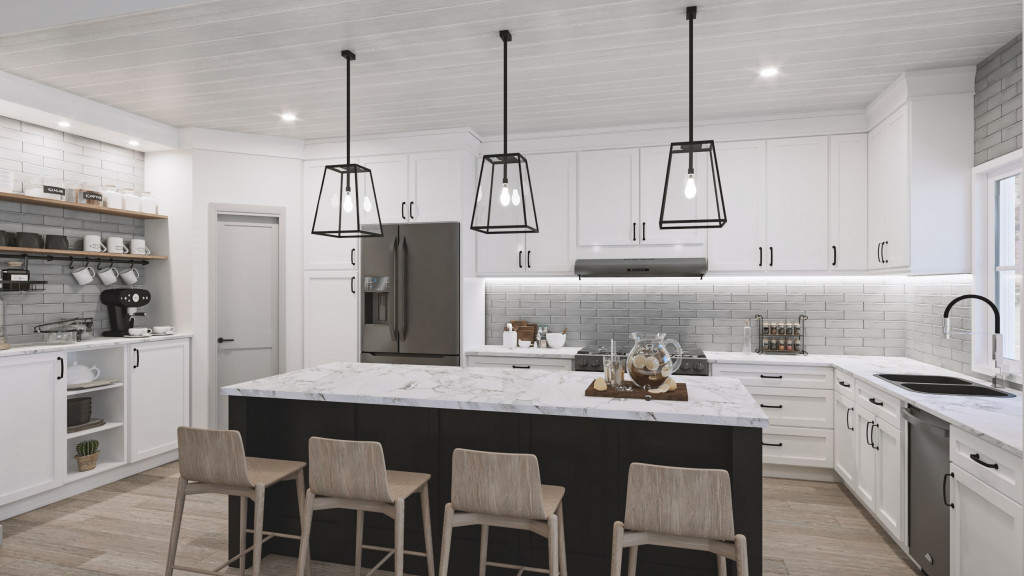
With the kitchen island already such a focal point, bold and vibrant colors like emerald green, navy blue, or even black let it make even more of a statement. Our kitchens tend to stick to a classic neutral color palette, and with a unique kitchen island tone, you add visual interest and contrast. A bold color keeps your kitchen island’s functionality but makes it fun.

A dark island pairs perfectly with this stone countertop!

Seating and Dining:

Keep your family connected by adding seating to this central kitchen unit. Bar-style seating is a great design idea that makes this space more livable and flexible, perfect for eating or working. By designing your kitchen island layout to include a row of bar stools, you can effectively set your kitchen up to act as the home’s central hub.

A kitchen island with space for dining.

How to find your perfect kitchen island

Finding the perfect kitchen island design for your family can be challenging, and G.J. Gardner Homes’ team of expert designers and decades of knowledge are here to help. Want to build a customized home that lets you personalize these crucial details? Contact our friendly team today.

A Guide to Changes to California’s ADU Laws (2023)

Why have the ADU Laws been changed?

Recently, changes were made to Californian ADU laws to incentivize property owners and developers to add these to their existing properties.

The California Legislature found that, among other things, ADUs and JADUs (junior accessory dwelling units) provide additional rental housing in areas that are perfect for single family and multifamily living.

As a result, they have been working to reduce the complexity of the process, encouraging the development of more ADUs to address the region’s evolving housing needs.

Through reducing the legal restrictions on ADUs and streamlining the approval process, homeowners and developers are encouraged to build more ADUs. This has the additional effect of providing more comparatively reasonably priced rentals for the residents of California.

Summary of Changes

The most recent round of changes came from several bills, all in the name of making ADUs more accessible to California residents. Here are some of the key changes for property owners and developers.

AB 345

The amendments to AB 345 have made it possible for ADUs to be sold separately from the home in some cases. Cases include when the ADU was built by a qualified not-for-profit, or is to be held as owner-occupied low-income housing for 45 years.

Note: this doesn’t apply to JADUs.

AB 3182

Amendments to AB 3182 address the approvals process and are designed to make the process more efficient from start to finish.

Primarily, if an ADU or JADU has not been approved by the local agency within 60 days, it will be deemed approved by default. You can now also gain approval for both an ADU and a JADU per lot, rather than needing to select one or the other. It also allows for the leasing or rental of ADUs or JADUs in common interest developments, and ensures 25% of these will be allocated as rentals.

AB 68, AB 881 and SB 13

Amendments to these bills are similarly intended to remove barriers that many people run into when looking to build ADUs.

Changes to these bills are more numerous and include:

  • removing minimum lot sizes for ADU builds,
  • clarifying that ADU requirements can be based on sewerage access, water access and impacts on traffic and public safety,
  • eliminating owner-occupancy requirements,
  • making it impossible for local agencies to enforce a maximum size of less than 850 square feet,
  • allowing converted ADUs (such as renovated garages or carports) to go without replacing on-street parking,
  • reduces the maximum approval wait time from 120 days to 60 days,
  • reduces impact fees,
  • allows JADUs to be constructed within the walls of an existing residence,
  • as well as explicitly clarifying some gray areas that caused confusion to some developers and builders.

AB 587, AB 670 and AB 671

Finally, the changes to the following bills are more related to Health & Safety law that sometimes prohibited the construction of accessory dwelling units.

The amendment to AB 587 creates an exception similar to AB 345, where some ADUs can be sold separately to the original dwelling so long as they adhere to ordinance that specifies the ADU is built by a non-profit for low-income housing.

AB 670 removes restrictions that would’ve unreasonably restricted ADU construction on a lot zoned for single family residential use.

Finally, revisions to AB 671 incentivizes the construction of ADUs for very-low through to moderate level income tenants, as well as pushing California’s HCD to collate resources to better facilitate the construction of these lower income ADUs.

At G.J. Gardner Homes, we’ve got years of experience in building ADUs. If any of the above is unclear, we can help you to work your way through the approvals process, ensuring all is above board and complies to local regulations.

Many areas in California now offer permit ready ADU plans, free for public use. We’ve collated some links below!

Contact us today if you’re interested in building an accessory dwelling unit on your lot.

How To: Maximize Storage in a Custom Home

When building a custom home, it’s easy to find yourself totally immersed in the design and style process while selecting your finishes; where you get to realize your dream and customize the home you’ve always wanted . However, there are some equally important but maybe less glamorous aspects to designing your home that should be considered that can have an impact on both how your home meets your needs while adding value to your investment. Namely, ensuring you have adequate storage.

So, how can you maximize your storage capacity? Hear more from the home building experts at G.J. Gardner Homes.

What Will Influence my Home’s Storage Capacity?

There are a few constraints that will have a marked impact on your storage capacity.

Budget

One of the most significant factors to influence a home build, your budget will ultimately determine a lot of the choices you make when designing a custom home. This includes your storage capacity.

Lot Size

It stands to reason that the more square footage you have available to build your custom home within, the more options for storage space you will have. If building on a smaller lot, you may need to get a little more creative!

Living Requirements

Your family size and living requirements will be a factor in overall storage capacity as well. More people often equates to more stuff, so big families may find themselves requiring more designated storage space.

Let’s dive into some recommendations specific to some key areas of the house.

Living Areas

Maximizing your storage space in family and dining rooms can be a big ask. These rooms serve the function of being a place to relax, connect and spend time with loved ones, which doesn’t always leave you with spare space for storage.

Our top living area storage tips:

  1. These rooms are largely multipurpose in nature, which gives you the unique opportunity to design storage in line with how you see yourself using them. For example, for a room with a fireplace centerpiece; consider adding recessed shelving and built-in cabinetry on both sides beside it to display your cherished memories, photographs and achievements, as well as being functional storage.
  2. Consider multi-purpose furniture, such as a storage ottoman. This gives you the best of both worlds!
An example of recessed cabinetry, used to display household decor.

Entryway

We are completely aware of the fact that a home’s front door and entryways often accumulate household stuff – shoes, keys, bags; the list goes on. Instead of tripping over these late at night, we suggest getting a little smarter with your entryway, whether it be the front, back or garage entry.

Our top entryway storage tips:

  1. Where space permits, consider adding a mudroom that can serve as a storage hub. The benefits of having a mudroom stretches beyond just storage, but it’s hard to deny that this is a key part of their appeal. Add coat racks, a cabinet for shoes and a bench with underseat storage, all neatly tucked away in a separate room.
  2. Where a mudroom is not possible, a wall-mounted rack for shoes, coats and hats along with a storage bench can keep things off the floor and out of the way.

Bedrooms, offices and flex spaces

Well-considered bedrooms, office and flex spaces are absolutely key to having enough storage in a custom home. This is especially true for growing families as children inevitably grow up and require more storage space with time. While furniture will be a huge factor here, your custom home build should also be considerate of growing storage needs!

Our top bedroom, office and flex room storage tips:

  1. Lean on your inbuilt closets as your main storage space. They won’t take up valuable floor space which comes at a premium in a bedroom.
  2. If you have the room, a walk in closet will provide you with more space than any other option.
  3. If you’re still struggling, under-bed storage and other furniture with built-in storage could help you out of a tight spot!

Kitchen

The kitchen can be famously hard to maintain control over. Counter space often ends up in high demand once dinner prep has started, you‘ve added some new appliances and you’ve just prepared an afternoon snack for the kids.

Our top kitchen storage tips:

  1. Consider adding a butler’s pantry to your kitchen. A butler’s pantry is a walk-in pantry or recessed serving area which often includes additional bench space, the less-used kitchen appliances and can even include additional sinks. This additional space maximizes kitchen storage and allows your main kitchen to be a tidy communal space.
  2. Think creatively about whether you can use overhead storage. Whether this is through floor-to-ceiling cabinetry or through hanging pots and pans above you, it’s possible to take advantage of free space above you in this way.
Some well-considered overhead kitchen storage solutions.

Garage

Perhaps the worst candidate for attracting clutter, your garage can actually be a storage lifesaver if designed well. Key to this is the fact that garages are generally larger in size when compared to other internal rooms of the house, allowing you to stretch your space further in your custom build.

Our top garage storage tips:

  1. Make use of heavy-duty shelving that can be installed around the perimeter. With heavy-duty shelves you can store pretty much anything, you’re just limited by size rather than weight or aesthetics.
  2. Consider the height of your ceiling and whether that will be a missed opportunity. Detached garages or sheds may give you more scope to go upwards, with custom shelving that reaches up to the ceiling.
  3. Garages are extremely versatile spaces. If you have a double garage, consider moving one of your cars elsewhere to really maximize the free space inside!

With a custom home, the possibilities are endless. G.J. Gardner’s experience in custom home building and smart storage solutions gives us unique insight into how exciting and rewarding an experience they can be! Contact us today to hear more about our custom home expertise, and how we can help you to realize your dream home.

How to Build a Custom Home: Our 8-Step Guide

Person holds new house keys

There’s nothing quite like the feeling of coming home to a space that is yours and has been completely customized to your tastes. From selecting land to drawing up home plans and watching the build take shape, a custom home build is truly a rewarding process, that not everyone gets the joy of experiencing.

But for those lucky enough to be considering a custom home build, it’s important to fully understand the building process and the steps involved in making your dream a reality. In this article, our expert new home consultants delve into the general stages you can expect to encounter on your custom home-building journey. As these stages are meant to be a guide only, please ask your custom home builder if there are any additional items to be aware of.

Step One: Preparation is Key

As the saying goes, preparation is key and the same applies to the custom home-building process. Before contacting a home builder, it is important to break down your budget and building time frames to determine if this avenue of home building is suitable for you.

Types of custom home budget costs to consider include:

  • Land cost
  • Local taxes, permits, and fees
  • Home builder and construction costs
  • Landscaping costs
  • Home furnishing costs
  • Mortgage and loan payments
  • Initial down payment
  • Padding (money set aside for unexpected costs during the build)

This budget breakdown can assist in determining the realistic size of your new home, locations, and land you can afford. On top of this, you should determine the desired timeframe for your custom home build and if you have any restraints. This could include finding and buying your land, end-of-home leases, school, new family members, and more.

If you are still researching the type of custom home build you are looking for, our Custom Home Designs page details the different levels of custom home builds and is a great guide for beginning your home build process. 

Step Two: Choosing A Custom Home Builder

Before deciding to embark on the custom home building journey and rushing into a decision, it is important to conduct research into home builders and find a reputable one that meets your needs. Whether you have an existing plot of land you’re building on or need help finding it, are looking to customize a standard plan or make some changes to an existing home design, different home builders offer different types of services.

Research online first by investigating the home builder’s experience, custom home expertise and previous completed projects to get a better idea of their capabilities and expected outcomes for your custom home build. This can set your expectations going into initial consultations with your chosen builder later and glean insight into the parameters for your custom build project.

For example, at G.J. Gardner Homes, our expert custom home builders and new home consultants are readily available in-house. This saves you the trouble of putting together a custom home-building team with a range of third-party contractors. Simply attend an initial consultation to determine the degree of customization required and the team can provide design plans, assist with permits and other building needs including helping you locate your land to build on.

Step Three: Design Your Dream Home

After selecting your home builder and securing your land, it is time to start drawing up your dream home design and future floor plan. For your first consultation with your home builder, it is important to bring to the meeting a list of wants and needs with a level of importance in mind.

Consider the following:

  • Number of bedrooms and bathrooms
  • Garage size
  • Room arrangements and preferred floor plan layouts
  • Overall size of the home
  • How many stories are in the home
  • Budget
  • Architectural and interior design style
  • Negotiable inclusions (e.g. pool, covered patio, fireplaces, wine cellar, media room)

Alternatively, if you don’t want to start your home design from scratch, it is likely your builder will have existing home design plans to choose from and further customize.

Following this first meeting, the home builder will draw up your custom home design plans into a floor plan along with an estimated price of the complete custom home build called a purchase agreement. Upon review of these documents, you can provide feedback, edits, and changes to the floor plan and materials used to reduce costs if needed or add new features to the home.

Step Four: Obtain Financing

Upon the completion of the home floor plan and cost estimations, it is time to consider how you will finance your home build. This could be through a construction loan, cash, or a combination. It is recommended if you are planning to secure financing through a third party, you speak to your local lender or mortgage broker to explore the most suitable options available to you.

Step Five: Finishes & Fixtures

Arguably the best part of the design process, it’s now time to select your preferred finishes and fixtures. This includes countertops, flooring, hardware, lighting, windows, trim, cabinetry and more. Your new home consultant should walk you through the options available depending on the level of customization desired.

Step Six: Construction Starts

Once the final floor plan and purchase agreement are signed and settled, the construction and building phase can begin. This tends to happen in stages but, you can expect the following:

  • Site clearing and preparation
  • Foundations, framing, and roof
  • Utility installation
  • Insulation and drywall
  • Flooring, lighting, paint and millwork
  • Fixtures and appliances
  • Finish work such as final paint, wall coverings, trim
  • Landscaping

This is such an exciting time in your custom home build journey as you can see your plans come to life in physical form!

Step Seven: Final Walk-Through

After the custom home build has been completed, you will do a final walk-through. This is an opportunity to inspect the home and ask questions before the official closing of the home. In addition, during this walk-through, you will go through each room of the home and do a final check.

Step Eight: Closing The Home

Following your final walk-through and closing your home builder will hand over the keys to your new home and you will take possession of the property.

At G.J. Gardner Homes, we specialize in custom home builds with extensive and proven experience in creating tailored home solutions for customers across the country. If you are considering a completely custom home design or a semi-custom home, our team is here to help. Benefit from our stress-free build process honed with decades of building experience.

Want to learn more? Contact our home design experts today by visiting our website.

How Much Does it Cost to Build a Custom Home?

If you have been wondering how much it costs to build a custom home, then you have come to the right place!

Custom homes come with the luxury of hand-picked materials, layouts, and styles, to guarantee you match your taste and lifestyle. From floor plan edits to changes to finishes, custom homes allow you to turn your dream home into a reality.

What does it cost to build a custom home?

The short answer: According to the latest National Association of Home Builders (NAHB), the median price for a custom-built home is around $424,000. The average cost for a built home on the market is 417,700. building a custom home costs slightly more than buying a built home.

However, The total cost of a custom home depends on several variables.

What affects the cost of custom-built homes?

The price of a custom home will depend on how much you customize your home. The more you customize the more the home is going to cost. Let’s break down the main factors that determine the price.

Materials

Custom homes allow you to decide what materials will work best. Many materials you see are flooring, finishes, and structural elements. These can vary majorly in the home building industry and cause final project prices to vary.

Finishes and features like marble, stonework, and other rare raw materials increase the costs. They are often higher ticket purchases and they require more care and expertise to install.

Your choice of materials is an opportunity to keep costs down or increase them.

Time

Some builders allow you to choose pre-designed, semi-custom, and fully customizable homes. All three of these build types have varying time frames. A general rule of thumb is that having a longer build process may increase labor costs.

When you build standard and semi-custom homes each design has a set timeline. For example, at G.J. We developed our home designs with decades of home crafting, allowing us to offer set timelines.

When you choose a fully custom home, your timeline varies significantly depending on how much of your build process you have finished. Having land ready to go and having an idea of what you want makes the process much faster. Other factors like size and finishes also make a world of difference.

Size

The price of your home will simply reflect its size. Bigger homes require more materials and labor than smaller homes. In conclusion, the cost to build a custom home will depend on the number of bedrooms, bathrooms, and living areas you’re looking to build and the overall square footage.

Location

The price of everything varies dramatically across the country, and homes are no exception. The final cost will depend on your state, proximity to urban centers, and access to materials and labor.

The range of factors that can impact the final price of a custom home just shows the endless possibilities you have when customizing. While it may cost more, a custom home also comes with ample benefits.

Why build a custom home with G.J. Gardner Homes

G.J. Gardner Homes are distinguished for their experience and expertise we make it easier to get everything you want in a home without all the extra costs and mistakes.

With standard plans, semi-custom and fully custom packages on offer, you can find a home-building journey that works with your preferences and goals.

Our homes are the product of hundreds of hours of professional input as we’re committed to creating spaces that are a joy to live in. Experience every detail of your home before it’s built with our 3d planning available during the design phase. With no detail missed, G.J. Gardner Homes is ready to ensure your custom home is everything you imagined.

Get in Touch

Are you looking to discover more about the custom home-building experience? Our friendly G.J. Gardner Homes team is here to help. If you don’t know where to start, have land already, or are anywhere in between, our new home consultants are ready to work with you. Find your nearest showroom here.

Things To Know When Building A House In A Flood Zone

Whether you’re looking to build your dream house on the coast, construct a home with picturesque lakeside views or have found an affordable plot of land in a low-elevation area, you may not have considered the added building regulations and insurance policies required for you to live out our American dream.

In the United States, it is estimated there are over 41 million people living in flood zones. But many homes in these high-risk areas and beyond are not insured and have not been built in a way that mitigates the residential building from flood damage.

Common Causes of Flooding

Across America, there are primarily three main causes of flooding: coastal flooding, riverine flooding, and pluvial flooding. Coastal flooding refers to flooding from tide or storm surges because of hurricanes, tropical storms or other extreme weather events. Whilst riverine flooding refers to flash flooding or overbank flooding that occurs when a body of water overflows its banks or when flood defenses fail.

Finally, pluvial flooding or surface flooding refers to flooding due to stormwater and rainfall flooding, along with areas experiencing tropical depression. This type of flooding has become a widespread issue within the U.S. this year with flash flooding and rainfall flooding impacting regions such as Florida, Missouri, Illinois, Virginia, Las Vegas, St. Louis, Arizona, Phoenix and California

But with the correct planning, paperwork and flood-proof home design, living in a flood-prone area doesn’t have to be doom and gloom. As home builders with decades of experience, in this article, our expert builders will detail some key considerations for building a home in flood-prone areas.

Understand The Risk & Requirements:

The first step when building a flood zone house design is to research and fully understand the risks and requirements associated with the project. In the United States, governing bodies such as the Federal Emergency Management Agency (FEMA) have mapped out all the regions and defined them in alignment with the level of flood risk. This is broken down into four main categories highlighted in the tables below.

Special Flood Hazard Areas (SFHA)

Flood Risk TypeDescriptionRequirements
V ZoneThe most hazardous area with a high-risk for flooding with a 25% risk of floodingMandatory flood insurance
VE ZoneCoastal areas with 1% or more chance of flooding each yearMandatory flood insurance
A ZoneHigh risk for flooding located near waterMandatory flood insurance
AE Zone (previously A1-A30 zones)Base floodplainMandatory flood insurance
AH Zone1% chance of shallow flooding ranging from 1 feet to 3 feetMandatory flood insurance
AO Zone1% or more chance of shallow flooding located near a river or a streamMandatory flood insurance
AR ZoneTemporarily increase flood risk due to building or flood control restorationMandatory flood insurance
A99 Zone1% chance of flooding & protected by federal flood control systemsN/A

Moderate Flood Hazard Areas (MFHA)

X ZoneModerate risk of floodingInsurance is not mandatory
B ZoneModerate risk of floodingInsurance is not mandatory

Minimal Flood Hazard Areas

X ZoneMinimal risk of floodingInsurance is not mandatory
C ZoneMinimal risk of floodingInsurance is not mandatory

Undetermined Flood Hazard Areas (UFHA)

D ZoneRisk of flooding is unknownInsurance is not mandatory

To learn if your block of land is impacted by these flood hazard areas, head to the FEMA flood map service center to enter your address.

It is also important to consider the depth of flooding common within the area along with the overall risk of flooding, as this will impact the regulations and building materials required to construct your new home.

Elevated House Plans For Flood Zones

After assessing the level of flooding risk and whether insurance is mandatory for your home build, it is important to consider how your home design will be impacted and the necessary features required to minimize property damage and mitigate against flooding.

The base flood elevation (BFE) level should be considered here. This refers to the height at which the floodwater would rise during a base flood (the flood with a 1% chance of occurring in any given year). As mentioned above, this should be detailed for Special Flood Hazard Areas (SFHA) by the FEMA flood maps for areas expected to have the most impact from flooding.

When building a new residential home in a flood-prone area, it is important to build above this base flood elevation line as this can reduce home flood insurance premiums and protect the home from damage.

You could also be eligible for the insurance premium to be waived to get the property removed from the flood floor plans if you can prove your property or home design is above the 100-year base flood elevation level. However, you will require a formal document from FEMA to do so. We recommend getting a land surveyor or civil engineer along with your home design consultant to work through the FEMA removal process on your behalf.

Home Building Considerations for Flood-Prone Areas

After considering structural elevation levels and flood zoning risk it is time to consider flood-safe building materials and design inclusions to ensure your home is built to stand the test of time. It is important to select home foundation types and building materials that withstand water damage or flowing water impacts.

Foundation Types:

Typically, for homes in flood-prone areas, the main home foundation types include slab-on-fill, perimeter walls, standing on piers, posts or columns and piles. However, the correct foundation type will depend on the state and city requirements for flood-prone foundations and flooding risk. When building your custom flood home design, be sure to speak with your builder about the correct solution for your future home.

Other Options:

Other building inclusions and home flood mitigation options include flood vents or foundation vents on lower levels of the home which ensure hydrostatic pressure does not build up to impact walls and home foundations. Another tactic includes placing service equipment and utilities above the base flood elevation level which can minimize the risk of water damage to these appliances causing damage to household members and the wider community if a flood were to occur.

These inclusions can be discussed with your home builder in the initial design and consulting phase to determine the relevancy and efficiency of these features in your new home.

Flood Zone House Designs

Once you have thought through these initial considerations and discussed them with your home builder, you should be able to mitigate flood risks and keep your home protected and prepared for flooding long into the future.

At G.J. Gardner Homes USA we offer a variety of homes for sale along with our classic home designs. We are also specialists in custom home designs, meaning we can tailor your home design to suit your personal preference and design choices (including flood protection).

If you’re looking to build in a flood-prone area but don’t know where to begin, contact our friendly team and inquire today to get started!

5 reasons to Build Your Home in California 2024

Most know California for its laid-back lifestyle, natural beauty, and phenomenal weather. From the rugged coastline of Big Sur to the towering Redwoods of the North, California’s world-famous landscapes have set the tone for life in the Golden State. here are 5 reasons to build your home in California.

Why We Love California Living

Nearly perfect weather year round

California celebrated its perfect weather, with 278 days a year being sunny. Their lifestyle takes any opportunity to let the light in. In addition, studies have shown that living in temperatures higher than 60 degrees can significantly impact and maximize happiness.

The great outdoors

From orange sand deserts to some of the country’s best beaches, California boasts a diverse landscape, all within one state. Find the perfect break along the 840 miles of coastline or summit exciting hikes in one of the state’s nine national parks.

The state’s best cities provide perfect proximity to these world-class natural wonders. Working with a great designer can help you make the most of the California landscape. With an emphasis on indoor-outdoor, windows, and open plans, California living celebrates its landscape whether you’re outside or in.

More bang for your buck

While California living is reported as one of the ten most expensive states in the country, California living is an unmatched experience compared to the list’s other locations.

Compared to other states with high living costs, such as Hawaii, Massachusetts, Maryland, Connecticut, and California offers adventure and industry. Home to the country’s fastest-growing tech center and agricultural market, California’s cost of living is better value than most.

Endless experiences

you might never get bored in this West Coast hub because of how much there is to do. California has something for everyone with plenty of fun for families, couples, and singles to enjoy.

It’s home to some of the world’s most coveted weekend trips from Big Sur road trips up the beautiful coastline to camping on Lake Tahoe. You can even escape the outdoors and explore the museums and historical centers of San Francisco or the 60s glamour of Palm Springs. Brimming with bucket list items, California residents aren’t short of things to do.

Big Sur

Home designs

Californian homes celebrate natural materials like wood, stone, and glass to create a one-of-a-kind look. Also, Due to the state’s rich heritage, the cultural identity includes many rustic elements mentioned above. Californian homes offer a beautiful feel and flair ranging from Spanish-inspired tile work to the organic shapes of Mexican adobe.

With organic materials, bohemian decor, and minimal modernist features, Californian homes are designed to be spacious, classic, and inviting. Under the influence of their open and relaxed identity, Californian living has seen most of today’s homes use an open plan to form its central living hub and lead effortlessly into the alfresco. Indoor-outdoor living encourages you to get outdoors more by making it more accessible and usable and with the perfect weather to enjoy.

Best Places to Live in California

G.J. Gardner Homes is building across many of California’s leading communities and cities. From Sacramento to San Diego, our offices offer our clients access to some of California’s best places to live.

Explore our California home builders now and discover your next steps for building in California.